How is it that I always end up blogging when I have the most work to do? Ahh! Then again, I suppose the rest of this week won't be too different from today--on top of usually long daily lessons, we have our midterm on Friday, which means I need to start reviewing all those 生词 (new characters/words) from previous weeks. 哎呀,糟糕!
I suppose the most interesting thing to note from the past few days is that I've finally started to explore Beijing on my own, rather then relying on my teachers to take me places or staying in my dorm and studying all day. On Friday, after meeting up with Grace Kim (CET) in Wudaokou, a few DSICPers and I checked out Chaoyang District's Club Babyface. It was a little small, but admission was free and the music was good, so the overall experience was pretty decent.
The next morning, I somehow managed to wake myself up by 8:30 to go to 颐和园 (Summer Palace) for a tour led by the teachers. It was definitely one of the most beautiful places I've visited so far in Beijing, and I enjoyed the morning there despite the intermittent rain and ridiculous heat. After getting back to our dorms, I felt pretty tired, so I took a nap (睡午觉!) for six hours. (Side note: I felt really really cold after waking up, even though the weather was super hot and my A/C wasn't turn up that high. Weird?)
That night, at the suggestion of some teachers and friends, I took a cab to Sanlitunr--first to eat, then to play. The restaurant I went to is called Bellagio, and it's pretty high-class, even by American standards. Interestingly, all the fuwuyuans were women with really short hair, so I spent a few minutes debating with my friend whether or not they were forced to cut their hair after starting to work there. Our conclusion? No clue.
Everyone else was tired, so my friend and I decided to check out Club Mix by ourselves. If you're not familiar with Beijing nightlife, Club Mix is probably one of the biggest and most famous nightclubs in the city; needless to say, I was pretty excited. The entrance fee was a little steep (50 yuan, about $7USD--clearly, my standards have dropped). However, the reason for this exorbitance quickly became clear: Mix has two huge dance floors, each with its own bar, DJ, and giant LCD screen. The floor was super crowded, so there wasn't much room for movement (or breathing), but I gradually adjusted to the atmosphere, and three hours later I had danced to my heart's content. By some strange coincidence, I later found out that some of the people I had danced with are HBA students, including a Yalie. Beijing sure is a small city.
Sunday was also very interesting. My language partner (yuban, hereafter) had asked me to show her what church in China is like, but since Chinese citizens aren't allowed to go to BICF, the international fellowship that I attend, my friend and I took our yubans and one of their friends to the state-run "Three Self" church. The service was all in Chinese, so I couldn't understand a single thing; however, it did seem like everyone else was pretty engaged, so I assume good words were spoken. Our ensuing discussion was also rather thought-provoking, particularly when my yuban's friend found out that I was a physics major. For some reason, she simply could not fathom how a person could study science and still be religious. Because my Chinese is still very lacking, I wasn't able to respond as well as I would have liked to; however, I still feel that even being able to initiate this kind of conversation with a Chinese native is one of the biggest benefits of coming here to study.
Yesterday, my yuban, her friends, their yubans, and I all went to a 小公园 (small park) to have a picnic. Apparently, "small" in China doesn't actually mean small: the park had an enormous lake complete with boat rentals, a bridge, and a scenic trail around its perimeter. We first rode paddle boats for an hour, during which I quickly discovered how out of shape I've become. Then we walked around the park and found a nice, shady spot to sit down and eat snacks. It was probably the first time I've really been able to relax and unwind since I got to Beijing, and I would definitely like to go back before I'm done with the program.
Speaking of coming and going, I've noticed an unfortunate but not-so-odd trend. Foreigners such as myself come to China to study Chinese language and culture, yet once we get here (I say we because I'm often guilty of this as well), we fall into the trap of only wanting to do things that are familiar, and therefore comfortable. For example, in my three and a half weeks of living in Beijing, I've probably eaten American and Korean food as many times as I've eaten Chinese food, if not more often. And what do I do with my block of free time every weekday afternoon? I stay in my air-conditioned dorm room and use the internet, as unreliable as it may be. My goal for the remainder of my stay in China is to integrate myself into the Chinese lifestyle more, even if it means sacrificing some conveniences and having to accept different viewpoints on what's "good" and what's "bad." Maybe in the end, those viewpoints will become my own. That would be a huge but awesome step in my studies.
Does anybody else use that little side scroll bar to judge how much they've written? Mine is about a centimeter long now, which I take to mean that I've written just enough to be thorough but not enough to bore everyone (hopefully). See you after the midterm, probably!

2008/07/04
Week three, plus laundry strife
I figured I'd write another entry before the list of things I have to blog about got too long.
Last Sunday was fun. After church, a couple fellow DSICPers and I met up with Susie, Carol, and Cole in Wudaokou--home of Peking University, Tsinghua University, and, most importantly, many many delicious Korean restaurants. Carol took us to a nearby Korean BBQ restaurant for a delicious and long-forthcoming meal that included 삼겹살 and 차돌, two types of meat that I've been craving ever since I left LA. Afterwards, I went to a Korean bakery/cafe called Tous Les Jours near the subway station and ordered a huge (like, really really huge) bowl of 팟빙수. I also bought several types of bread (they have a Totoro roll!), which I originally intended to save for breakfast but couldn't resist eating that evening. This happens rather often, actually. Someone needs to invent a food safe that only opens in the morning. Yes, that would be good.
Anyway, after that Sunday and until today, my week passed by rather uneventfully. One notable thing to mention is that my Chinese has definitely improved from before. Not that I believed it wouldn't, but I never expected to be able to converse freely (albeit about simple topics) just three weeks into the program. Surprisingly, the most useful tools for my language acquisition haven't been classwork assignments, but rather the language pledge and the daily conversations I have with my language partner. It makes me wonder, with this rate of improvement, how fluent will I be by the end of summer? Hmm...
Today, I went to a huge Korean restaurant near campus with my roommate and two of his friends. While their beef and eggplant fried rice was quite delicious, the 불고기 left much to be desired. I'm willing to give the restaurant another chance though. Perhaps next time I'll try the 갈비. Afterwards, I was still a little hungry, so I went to the convenience store and bought a snack called Pejoy (百醇) which resembles Pocky, except it has cracker on the outside and filling on the inside. Absolutely delicious. More on Pejoy in a later post, when I can upload photos of the experience.
One more thing to mention before I go. I've discovered that doing laundry here is a huge hassle. At Yale, I only did laundry about once every two or three weeks because I had better things to do with my time, but here that is not an option, since I only have about a week's worth of clothes. So this is what I have to go through every time my sock supply starts running low: I pile up all my dirty laundry on top of one of my towels; gather up the corners and carry the entire load thusly; walk up and down the stairs looking for a free machine; realize I forgot to bring detergent and go back to get it (I've done this every time so far); stuff all my laundry in the machine and pour in the detergent; start the machine and head back to my room to study; come to pick up the laundry an hour later only to find that my white clothes have turned un-white; carry the load back to my room; lay out the (dripping) laundry on any and every open surface I can find; cry myself to sleep because I won't have dry clothes to wear the next day.
Okay, so I don't cry myself to sleep. But rawr! Anyway, I should go to bed since we have our exam tomorrow. Good night, everyone.
Last Sunday was fun. After church, a couple fellow DSICPers and I met up with Susie, Carol, and Cole in Wudaokou--home of Peking University, Tsinghua University, and, most importantly, many many delicious Korean restaurants. Carol took us to a nearby Korean BBQ restaurant for a delicious and long-forthcoming meal that included 삼겹살 and 차돌, two types of meat that I've been craving ever since I left LA. Afterwards, I went to a Korean bakery/cafe called Tous Les Jours near the subway station and ordered a huge (like, really really huge) bowl of 팟빙수. I also bought several types of bread (they have a Totoro roll!), which I originally intended to save for breakfast but couldn't resist eating that evening. This happens rather often, actually. Someone needs to invent a food safe that only opens in the morning. Yes, that would be good.
Anyway, after that Sunday and until today, my week passed by rather uneventfully. One notable thing to mention is that my Chinese has definitely improved from before. Not that I believed it wouldn't, but I never expected to be able to converse freely (albeit about simple topics) just three weeks into the program. Surprisingly, the most useful tools for my language acquisition haven't been classwork assignments, but rather the language pledge and the daily conversations I have with my language partner. It makes me wonder, with this rate of improvement, how fluent will I be by the end of summer? Hmm...
Today, I went to a huge Korean restaurant near campus with my roommate and two of his friends. While their beef and eggplant fried rice was quite delicious, the 불고기 left much to be desired. I'm willing to give the restaurant another chance though. Perhaps next time I'll try the 갈비. Afterwards, I was still a little hungry, so I went to the convenience store and bought a snack called Pejoy (百醇) which resembles Pocky, except it has cracker on the outside and filling on the inside. Absolutely delicious. More on Pejoy in a later post, when I can upload photos of the experience.
One more thing to mention before I go. I've discovered that doing laundry here is a huge hassle. At Yale, I only did laundry about once every two or three weeks because I had better things to do with my time, but here that is not an option, since I only have about a week's worth of clothes. So this is what I have to go through every time my sock supply starts running low: I pile up all my dirty laundry on top of one of my towels; gather up the corners and carry the entire load thusly; walk up and down the stairs looking for a free machine; realize I forgot to bring detergent and go back to get it (I've done this every time so far); stuff all my laundry in the machine and pour in the detergent; start the machine and head back to my room to study; come to pick up the laundry an hour later only to find that my white clothes have turned un-white; carry the load back to my room; lay out the (dripping) laundry on any and every open surface I can find; cry myself to sleep because I won't have dry clothes to wear the next day.
Okay, so I don't cry myself to sleep. But rawr! Anyway, I should go to bed since we have our exam tomorrow. Good night, everyone.
2008/07/01
北韩
As long as I'm not studying for my 听写 tomorrow, I might as well do something constructive instead of agonizing over how slow Facebook is in China. Before I go on though, I should say that this entry has very little to do with China, and most of it is actually rather depressing, so if you're just looking for more pictures and stories of my adventures in Beijing, it's probably a good idea to stop reading now.
I've been a little out of the loop in terms of US and world news lately, mostly because my internet is usually too slow or too restrictive to access news sites and because I can't read Chinese newspapers. So I was fascinated to read today that North Korea, as part of the six-party talks, has finally produced the nuclear declaration that was due at the end of last year. In exchange, the US has agreed to lift trade sanctions and remove North Korea from its list of countries that endorse terrorism. On the surface, this seems like rather good news; however, after looking into the matter a bit more, I discovered that the document is incredibly lacking, to the extreme that it might be doing more harm than good. As Donald Kirk writes in this Asia Times article, the document says very little about North Korea's uranium enrichment program and nothing at all about the plutonium produced for nuclear warheads at Yongbyon, nor does it mention North Korea's contribution to the proliferation of nuclear technology in the Middle East. Strikingly, the document does not mention the specific laboratories and facilities where nuclear research in North Korea is carried out. A little suspect, I would say.
And then there's the highly symbolic act of blowing up the cooling tower at the Yongbyon nuclear reactor for (almost amusingly) just one news network from each of the five other countries involved in the six-party agreement. I say "highly symbolic" because it really is just that--the cooling tower is just a cooling tower, and if I learned anything during my seminar about radiation and nuclear technology last year, it's that a cooling tower is not particularly difficult to (re)construct, compared to the rest of the reactor. On top of that, it's highly likely that North Korea has already used the plutonium generated at Yongbyon to build at least one, and probably more, nuclear warheads, whose whereabouts are completely unknown as of now. One pretty explosion should not be enough to appease those who are concerned about North Korea's entire nuclear program.
The politics are bad enough, but the cost of North Korean defiance in terms of human lives is a whole different monster. I read this particularly horrifying account of the torture and human experiments carried out at Camp 22, one of North Korea's largest concentration camps. Consider this quote by the former chief of management at Camp 22:
It's striking to note that his "opinions" weren't originally his; both victims and officials are brainwashed to believe that Kim Jong-Il is a deity, while the poor and homeless are the enemy of the state. This is not to downplay the individual acts of cruelty that occur daily in North Korean concentration camps, but it points to a larger and more widespread source of the problem--namely, the country's travesty of a government. North Korea probably has one of the most repressive regimes in history, and yet the US government is willing to overlook its atrocities for the sake of diplomatic relations. This isn't sustainable--it won't work because it can't work. The right to survive and live freely is not and should not be a political issue. It's good and all that we're trying to rid North Korea of its nuclear program, but if it comes down to that or improving the living conditions of the common people, I think it's obvious which issue is more pressing. (Not that I believe the dichotomy will ever be that clear-cut, of course.)
So, 怎么办? What to do? It's very hard to say, and if I had a good answer to that, the State Department would probably hire me today. But I have some suggestions, which generally fall under two categories: (1) short and long term relief for those who are suffering, and (2) bringing King Jong-Il's government to a long-awaited and absolute end. NGOs like LiNK, which both provide aid and work with government powers to make a tangible difference in North Korea, are doing an awesome job, but there are not nearly enough to help every starving and homeless person in the country. The governments of free nations should continue to provide food, ideally more than they're providing now, and make absolutely sure that the food goes directly to the people rather than through the government, which has a long history of clandestinely reallocating resources away from the people and to high ranking officials or the military. In addition, other nations, but the US in particular, need to stop being cheated by North Korean lies and funding the government when it is most desperate. Given the country's highly weak and unstable economy, applying even moderate, but firm and long-lasting, economic pressure is sure to topple to regime in the foreseeable future, as Lt. Col. Gordon Cucullu and Joshua Stanton suggest in this article. Finally, we need to give the North Korean people a sense of unity and let them know that being discontent with the government is not just acceptable but necessary in their situation. It is, of course, implicit that we would actually have to act on our promises to support them if the time called for it.
As discouraging as things in North Korea may seem now, I believe there is real hope for change in the future. Even the recent nuclear declaration, as much as I feel the need to criticize it, is a small step in the direction of opening the country for intervention. The tiniest step forward is better than retreat. My goal, then, is not to make huge sweeping changes on my own, but to spread awareness and show every person I can that there is a reason to care.
Addendum 1: Thank you Carol for introducing me to OneFreeKorea. It has a host of interesting and well-written articles about the situation in North Korea, including several about the current six-party talks.
Addendum 2: I'm not sure if I'm allowed to post an entry like this on my Light blog, so if I'm not, and someone from the office reads this, please let me know. I'd be glad to move it elsewhere.
I've been a little out of the loop in terms of US and world news lately, mostly because my internet is usually too slow or too restrictive to access news sites and because I can't read Chinese newspapers. So I was fascinated to read today that North Korea, as part of the six-party talks, has finally produced the nuclear declaration that was due at the end of last year. In exchange, the US has agreed to lift trade sanctions and remove North Korea from its list of countries that endorse terrorism. On the surface, this seems like rather good news; however, after looking into the matter a bit more, I discovered that the document is incredibly lacking, to the extreme that it might be doing more harm than good. As Donald Kirk writes in this Asia Times article, the document says very little about North Korea's uranium enrichment program and nothing at all about the plutonium produced for nuclear warheads at Yongbyon, nor does it mention North Korea's contribution to the proliferation of nuclear technology in the Middle East. Strikingly, the document does not mention the specific laboratories and facilities where nuclear research in North Korea is carried out. A little suspect, I would say.
And then there's the highly symbolic act of blowing up the cooling tower at the Yongbyon nuclear reactor for (almost amusingly) just one news network from each of the five other countries involved in the six-party agreement. I say "highly symbolic" because it really is just that--the cooling tower is just a cooling tower, and if I learned anything during my seminar about radiation and nuclear technology last year, it's that a cooling tower is not particularly difficult to (re)construct, compared to the rest of the reactor. On top of that, it's highly likely that North Korea has already used the plutonium generated at Yongbyon to build at least one, and probably more, nuclear warheads, whose whereabouts are completely unknown as of now. One pretty explosion should not be enough to appease those who are concerned about North Korea's entire nuclear program.
The politics are bad enough, but the cost of North Korean defiance in terms of human lives is a whole different monster. I read this particularly horrifying account of the torture and human experiments carried out at Camp 22, one of North Korea's largest concentration camps. Consider this quote by the former chief of management at Camp 22:
'I witnessed a whole family being tested on suffocating gas and dying in the gas chamber. The parents, son and and a daughter. The parents were vomiting and dying, but till the very last moment they tried to save kids by doing mouth-to-mouth breathing. [...]
'At the time I felt that they thoroughly deserved such a death. Because all of us were led to believe that all the bad things that were happening to North Korea were their fault; that we were poor, divided and not making progress as a country.
'It would be a total lie for me to say I feel sympathetic about the children dying such a painful death. Under the society and the regime I was in at the time, I only felt that they were the enemies. So I felt no sympathy or pity for them at all.'
It's striking to note that his "opinions" weren't originally his; both victims and officials are brainwashed to believe that Kim Jong-Il is a deity, while the poor and homeless are the enemy of the state. This is not to downplay the individual acts of cruelty that occur daily in North Korean concentration camps, but it points to a larger and more widespread source of the problem--namely, the country's travesty of a government. North Korea probably has one of the most repressive regimes in history, and yet the US government is willing to overlook its atrocities for the sake of diplomatic relations. This isn't sustainable--it won't work because it can't work. The right to survive and live freely is not and should not be a political issue. It's good and all that we're trying to rid North Korea of its nuclear program, but if it comes down to that or improving the living conditions of the common people, I think it's obvious which issue is more pressing. (Not that I believe the dichotomy will ever be that clear-cut, of course.)
So, 怎么办? What to do? It's very hard to say, and if I had a good answer to that, the State Department would probably hire me today. But I have some suggestions, which generally fall under two categories: (1) short and long term relief for those who are suffering, and (2) bringing King Jong-Il's government to a long-awaited and absolute end. NGOs like LiNK, which both provide aid and work with government powers to make a tangible difference in North Korea, are doing an awesome job, but there are not nearly enough to help every starving and homeless person in the country. The governments of free nations should continue to provide food, ideally more than they're providing now, and make absolutely sure that the food goes directly to the people rather than through the government, which has a long history of clandestinely reallocating resources away from the people and to high ranking officials or the military. In addition, other nations, but the US in particular, need to stop being cheated by North Korean lies and funding the government when it is most desperate. Given the country's highly weak and unstable economy, applying even moderate, but firm and long-lasting, economic pressure is sure to topple to regime in the foreseeable future, as Lt. Col. Gordon Cucullu and Joshua Stanton suggest in this article. Finally, we need to give the North Korean people a sense of unity and let them know that being discontent with the government is not just acceptable but necessary in their situation. It is, of course, implicit that we would actually have to act on our promises to support them if the time called for it.
As discouraging as things in North Korea may seem now, I believe there is real hope for change in the future. Even the recent nuclear declaration, as much as I feel the need to criticize it, is a small step in the direction of opening the country for intervention. The tiniest step forward is better than retreat. My goal, then, is not to make huge sweeping changes on my own, but to spread awareness and show every person I can that there is a reason to care.
Addendum 1: Thank you Carol for introducing me to OneFreeKorea. It has a host of interesting and well-written articles about the situation in North Korea, including several about the current six-party talks.
Addendum 2: I'm not sure if I'm allowed to post an entry like this on my Light blog, so if I'm not, and someone from the office reads this, please let me know. I'd be glad to move it elsewhere.
2008/06/28
Simatai Great Wall, and such
We're already a quarter done with the program. How ridiculous is that?
Anyway... One of the awesome things about DSICP is that the teachers take us on a trip every weekend to explore the sights of Beijing/China. It's a great way to alleviate the stress of having to study one lesson per day during the week, not to mention take cool photos and get to know my fellow students better. This weekend, we went to Simatai Great Wall to spend the night and then "watch the sunset" from the wall in the morning. I know it's more interesting to view photos from the experience than to read about it, but just to mention some highlights...

Our hotel looked really ancient, but I don't think it actually was.

My two roommates. So sensitive and in tune with nature.

Water droplets on the table at the restaurant we went to. The food was mediocre, unfortunately.

This one is particularly intense. I'm going to try to document all the different faces he makes in pictures.

I like how everyone is looking in a different direction. Sai Laoshi wins for looking at my camera.

Scenic view.

Behold, the reason why "watch the sunset" is in quotes. The fog made for some pretty photos though.
The internet is not being my friend today, so I'll have to cut this entry short. Before I go, I just want to mention two China-related articles (by the same author) that I find particularly interesting. One, which my friend Ricky mentioned in his latest blog post, is about the legendary "Great Firewall of China," how easy it is to bypass, and why it's effective anyway. The other looks at the opportunity for improvement inherent within the environmental crisis in China, without being naively optimistic. They're a little long, but definitely worth the read if you have some free time.
Bedtime for me. 晚安!
Anyway... One of the awesome things about DSICP is that the teachers take us on a trip every weekend to explore the sights of Beijing/China. It's a great way to alleviate the stress of having to study one lesson per day during the week, not to mention take cool photos and get to know my fellow students better. This weekend, we went to Simatai Great Wall to spend the night and then "watch the sunset" from the wall in the morning. I know it's more interesting to view photos from the experience than to read about it, but just to mention some highlights...
- Sleeping for the entire three-hour-long bus ride to Simatai
- Going on a mini hike after dinner on Friday
- Almost stepping on a centipede while showering (obviously, I use the word "highlight" loosely)
- Starting the trek up the wall at 3:00 am
- Struggling up what felt like a million steps, though in reality it was probably only a few hundred
- Finding a quiet rest stop ahead of everyone else and being able to listen to the sounds of nature for a while
- Millipedes... everywhere
- Crazy Chinese children's TV show about colors, numbers, and nonsensical English
- Five hour nap after returning to our rooms

Our hotel looked really ancient, but I don't think it actually was.

My two roommates. So sensitive and in tune with nature.

Water droplets on the table at the restaurant we went to. The food was mediocre, unfortunately.

This one is particularly intense. I'm going to try to document all the different faces he makes in pictures.

I like how everyone is looking in a different direction. Sai Laoshi wins for looking at my camera.
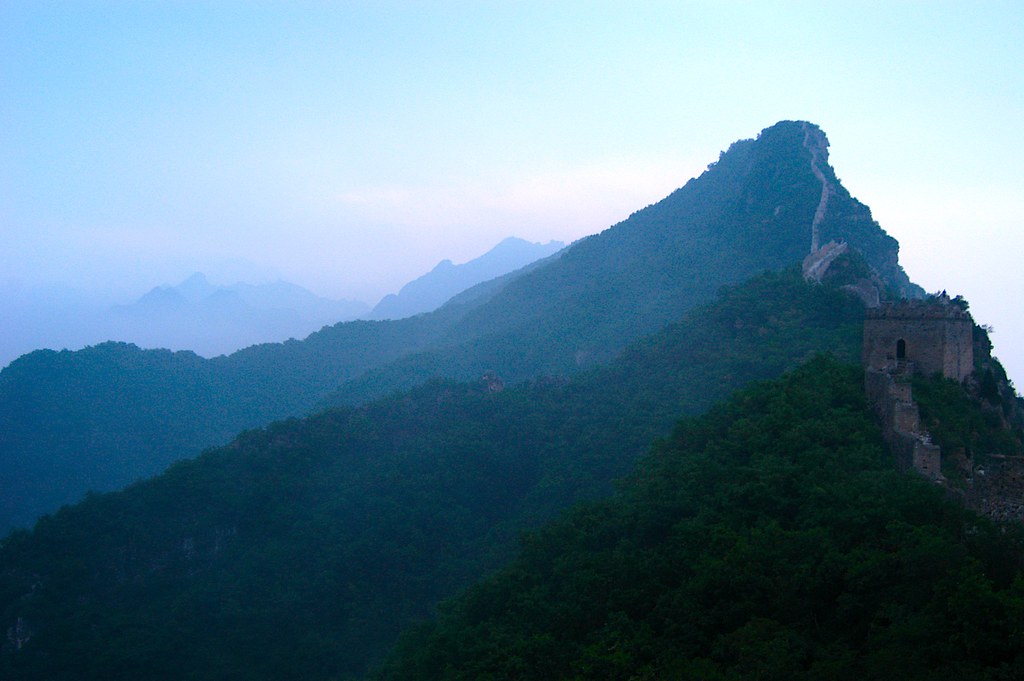
Scenic view.
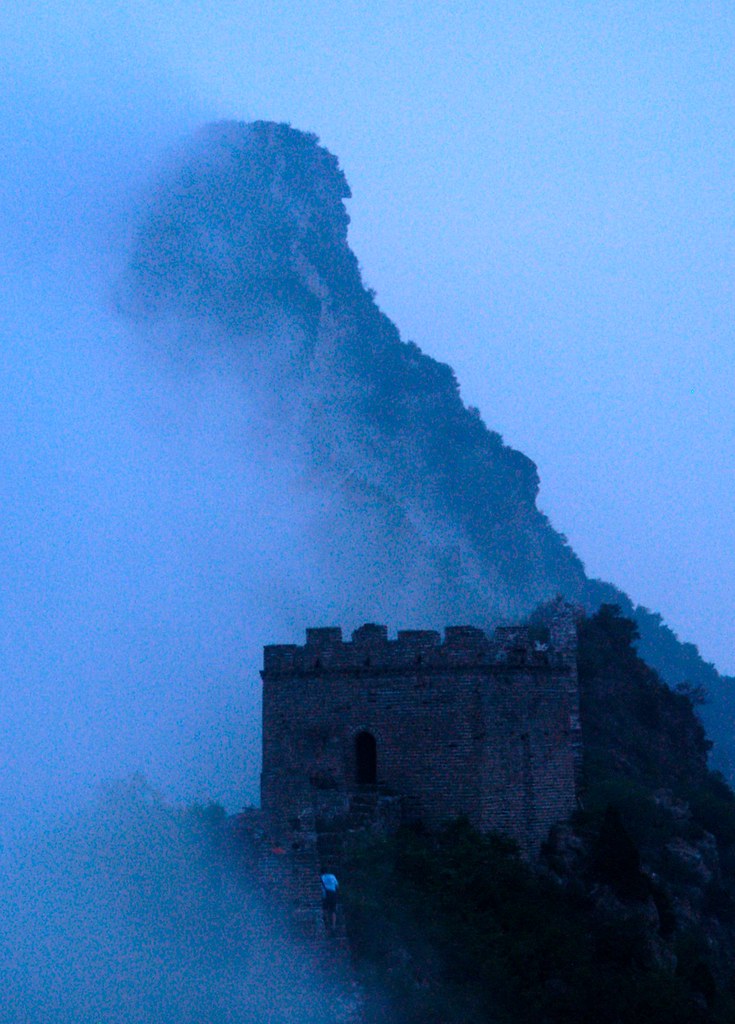
Behold, the reason why "watch the sunset" is in quotes. The fog made for some pretty photos though.
The internet is not being my friend today, so I'll have to cut this entry short. Before I go, I just want to mention two China-related articles (by the same author) that I find particularly interesting. One, which my friend Ricky mentioned in his latest blog post, is about the legendary "Great Firewall of China," how easy it is to bypass, and why it's effective anyway. The other looks at the opportunity for improvement inherent within the environmental crisis in China, without being naively optimistic. They're a little long, but definitely worth the read if you have some free time.
Bedtime for me. 晚安!
2008/06/26
The post you've all been waiting for
I'm currently at Yolanda Coffee, which is about a five minute walk from the CNU campus. I found out today that they offer "free" wireless internet, though it's not really free since you have to buy something from the relatively overpriced menu first. Anyway, the connection seems pretty fast and reliable, so I'm going to attempt to upload some of the photos I've taken so far.

A lovely way to start off: the pollution in Beijing is so bad that you can literally look at the sun (though you probably shouldn't). This is the sun as seen from the main entrance of our dormitory/classroom building.

My room when I first arrived. My side currently looks more or less the same as it did then, which is surprising, considering how cluttered my room at Yale was.

Some friends I met during the tour on the first day.

A transaction taking place in Hypermarket. That's right, it's not just a supermarket, it's Hypermarket.

A bicycle cart thingy outside the Thai restaurant I went to on the first weekend.

Yummyyy.

Yay for new friends!

My roommate, David. I'm pretty sure he's incapable of keeping a straight face on camera.

Awesome calligrapher in Gugong.

Another photo of Gugong.

Yet another photo of Gugong. I like the colors in this one.

Zhao Laoshi! The only male teacher for second year.

Roland, or as everyone here calls him, Ro Ro.

Mmm cheap, delicious jiaozi. You know you want some.

There he goes again.

Apparently KFC is a delicacy in China. We did not treat it as such, as you can see.
I'm about to run out of battery, so I'll upload more photos later. We're going to the Great Wall tomorrow and spending the night there, as long as the weather holds--pretty exciting stuff. But for now, I have to 好好(儿)学习 for my exam tomorrow. Until next time!
Edit
Back in my room, where the internet is spotty and the air is stale. Sigh.
So I was wondering why all my photos were the same size and looked underexposed/desaturated... Then I realized that I had uploaded the raw image files rather than the touched-up photos, which are in a different folder in my hard drive. (For any photography enthusiasts out there, I use Aperture v1.5.6.) Talk about 麻烦... Two hours of uploading--that is, two fewer hours of studying for my exam--and all I have to show for it are a bunch of washed out, 很难看 photos. Oh well. I hope you enjoy them anyway.

A lovely way to start off: the pollution in Beijing is so bad that you can literally look at the sun (though you probably shouldn't). This is the sun as seen from the main entrance of our dormitory/classroom building.

My room when I first arrived. My side currently looks more or less the same as it did then, which is surprising, considering how cluttered my room at Yale was.

Some friends I met during the tour on the first day.

A transaction taking place in Hypermarket. That's right, it's not just a supermarket, it's Hypermarket.

A bicycle cart thingy outside the Thai restaurant I went to on the first weekend.

Yummyyy.

Yay for new friends!

My roommate, David. I'm pretty sure he's incapable of keeping a straight face on camera.

Awesome calligrapher in Gugong.

Another photo of Gugong.

Yet another photo of Gugong. I like the colors in this one.

Zhao Laoshi! The only male teacher for second year.

Roland, or as everyone here calls him, Ro Ro.

Mmm cheap, delicious jiaozi. You know you want some.

There he goes again.

Apparently KFC is a delicacy in China. We did not treat it as such, as you can see.
I'm about to run out of battery, so I'll upload more photos later. We're going to the Great Wall tomorrow and spending the night there, as long as the weather holds--pretty exciting stuff. But for now, I have to 好好(儿)学习 for my exam tomorrow. Until next time!
Edit
Back in my room, where the internet is spotty and the air is stale. Sigh.
So I was wondering why all my photos were the same size and looked underexposed/desaturated... Then I realized that I had uploaded the raw image files rather than the touched-up photos, which are in a different folder in my hard drive. (For any photography enthusiasts out there, I use Aperture v1.5.6.) Talk about 麻烦... Two hours of uploading--that is, two fewer hours of studying for my exam--and all I have to show for it are a bunch of washed out, 很难看 photos. Oh well. I hope you enjoy them anyway.
2008/06/22
Week one, check
This entry may be a little long. Just a warning.
Where to start, where to start... I finally got some exercise on Thursday playing soccer with some DSIC and CNU students. I was exhausted after playing for just half an hour, though I'm not sure how much of that was because I'm out of shape and how much was because of the air pollution and lack of sufficient oxygen in my muscles. It was definitely fun though, especially getting to know the local students.
We had our first exam on Friday, and it was about as difficult as I expected it to be. The last question was an essay in which we had to use several of the grammar structures we had learned during the week. The prompt asked for 100 characters, which I thought was a lot at first, but after writing for a bit I realized that 100 characters wasn't even close to enough to express what I wanted to say. I guess I need to learn how to make my writing more concise. Afterwards, we had an oral exam during which we had to talk about our interview with a CNU student. We had all written a 200+ character essay about the interview, but many of us (including myself) didn't realize that we weren't supposed to look at the essay during the oral exam. I suppose it was silly of me to expect that we'd simply reading our essays aloud--it is an oral exam, not a reading exam, after all. Anyway, I was fortunate enough to have very nice teachers grading me, and they let me take a peek at my essay from time to time. I think I'll be more prepared next week.
That evening, the teachers treated us out to dinner at a pretty nice restaurant for our weekly "中文桌子," or "Chinese table." I got to sit with my two favorite teachers, which was pretty awesome. Amusingly enough, one of them ordered suanlatang and made the Yalies eat it. It wasn't as delicious as I expected, but I ate my fair share anyway. (For those of you who haven't taken Chinese 115, suanlatang is hot and sour soup, and it was in one of our dialogue about ordering food.)
Some fellow Yalies (but not DSICPers) were meeting up that night at Huixinqiaobeikou for karaoke, so after dinner, Lei Laoshi took us to the Chegongzhuang subway station on her way home, and we slowly worked our way to Huixinqiaobeikou from there. The Chinese subway system is surprisingly clean, modern, and convenient (and cheap of course), so I'll probably be taking it again in the future. Our friend Carol met us in the lobby of Partyworld, the karaoke place, and we spent a good couple hours singing and dancing and being silly in general. One thing I noticed was that all the Chinese songs at KTV are in traditional characters, but that's okay since people who sing those songs usually know the lyrics already (e.g. me singing Tong Hua). Afterwards, we said our goodbyes and took a taxi home, since the subway station was already closed.
Saturday was also a lot of fun. The teachers took us on a winding tour through Gugong, ending at Tiananmen. There was a lot of construction and repair work going on, which I can only surmise was because the upcoming Olympics. Fortunately, there were still many opportunities to take pretty photos, so my camera saw a lot of action. I really wish CNU's internet would stop being so slow and unreliable--at this rate, I'm not going to be able to upload pictures until I get to Korea in August. Anyway, after Gugong and Tiananmen, several students went to Xidan to eat and shop. I almost didn't go, but it's a good thing I did. Not only did I get to know my teachers better, but I also got to buy some good Chinese books (especially one called I Am Your Friend of Panda, whatever that means) at the huge Xidan bookstore, and really cheap clothes in the nearby shopping center. The title of master shopper goes to my friend Arjan though--he managed to buy a pair of shorts that were originally 400 yuan (~$60) for 100 yuan (~15). China is awesome like that.
After returning to CNU, my roommate and I watched 200 Pounds Beauty. Yes, that is the Korean movie about plastic surgery. No, I did not have to force him. I was actually pretty amused because he was able to guess a lot of the things that happen in the movie before they actually happened. His Korean movie watching skills are already well-developed, it appears. I wish I had Korean movies dubbed, or at least subbed, in Chinese, but I guess I'll have to satisfy myself with the two Chinese movies in my hard drive for now.
Today was my first time doing laundry at CNU. I had to search for fifteen minutes before even finding a machine that was free, after which I spent ten minutes trying to figure out how to put in detergent (Yale spoils us) and make the machine start. Actually, I should probably go get my laundry soon. I had to wash my whites with my colors, so I really hope the whites don't turn... not white. That would be very unfortunate. Wish me luck.
Edit
My socks and white shirts are now light sky blue. Fantastic. I suppose it could have been worse--at least they didn't turn pink.
Where to start, where to start... I finally got some exercise on Thursday playing soccer with some DSIC and CNU students. I was exhausted after playing for just half an hour, though I'm not sure how much of that was because I'm out of shape and how much was because of the air pollution and lack of sufficient oxygen in my muscles. It was definitely fun though, especially getting to know the local students.
We had our first exam on Friday, and it was about as difficult as I expected it to be. The last question was an essay in which we had to use several of the grammar structures we had learned during the week. The prompt asked for 100 characters, which I thought was a lot at first, but after writing for a bit I realized that 100 characters wasn't even close to enough to express what I wanted to say. I guess I need to learn how to make my writing more concise. Afterwards, we had an oral exam during which we had to talk about our interview with a CNU student. We had all written a 200+ character essay about the interview, but many of us (including myself) didn't realize that we weren't supposed to look at the essay during the oral exam. I suppose it was silly of me to expect that we'd simply reading our essays aloud--it is an oral exam, not a reading exam, after all. Anyway, I was fortunate enough to have very nice teachers grading me, and they let me take a peek at my essay from time to time. I think I'll be more prepared next week.
That evening, the teachers treated us out to dinner at a pretty nice restaurant for our weekly "中文桌子," or "Chinese table." I got to sit with my two favorite teachers, which was pretty awesome. Amusingly enough, one of them ordered suanlatang and made the Yalies eat it. It wasn't as delicious as I expected, but I ate my fair share anyway. (For those of you who haven't taken Chinese 115, suanlatang is hot and sour soup, and it was in one of our dialogue about ordering food.)
Some fellow Yalies (but not DSICPers) were meeting up that night at Huixinqiaobeikou for karaoke, so after dinner, Lei Laoshi took us to the Chegongzhuang subway station on her way home, and we slowly worked our way to Huixinqiaobeikou from there. The Chinese subway system is surprisingly clean, modern, and convenient (and cheap of course), so I'll probably be taking it again in the future. Our friend Carol met us in the lobby of Partyworld, the karaoke place, and we spent a good couple hours singing and dancing and being silly in general. One thing I noticed was that all the Chinese songs at KTV are in traditional characters, but that's okay since people who sing those songs usually know the lyrics already (e.g. me singing Tong Hua). Afterwards, we said our goodbyes and took a taxi home, since the subway station was already closed.
Saturday was also a lot of fun. The teachers took us on a winding tour through Gugong, ending at Tiananmen. There was a lot of construction and repair work going on, which I can only surmise was because the upcoming Olympics. Fortunately, there were still many opportunities to take pretty photos, so my camera saw a lot of action. I really wish CNU's internet would stop being so slow and unreliable--at this rate, I'm not going to be able to upload pictures until I get to Korea in August. Anyway, after Gugong and Tiananmen, several students went to Xidan to eat and shop. I almost didn't go, but it's a good thing I did. Not only did I get to know my teachers better, but I also got to buy some good Chinese books (especially one called I Am Your Friend of Panda, whatever that means) at the huge Xidan bookstore, and really cheap clothes in the nearby shopping center. The title of master shopper goes to my friend Arjan though--he managed to buy a pair of shorts that were originally 400 yuan (~$60) for 100 yuan (~15). China is awesome like that.
After returning to CNU, my roommate and I watched 200 Pounds Beauty. Yes, that is the Korean movie about plastic surgery. No, I did not have to force him. I was actually pretty amused because he was able to guess a lot of the things that happen in the movie before they actually happened. His Korean movie watching skills are already well-developed, it appears. I wish I had Korean movies dubbed, or at least subbed, in Chinese, but I guess I'll have to satisfy myself with the two Chinese movies in my hard drive for now.
Today was my first time doing laundry at CNU. I had to search for fifteen minutes before even finding a machine that was free, after which I spent ten minutes trying to figure out how to put in detergent (Yale spoils us) and make the machine start. Actually, I should probably go get my laundry soon. I had to wash my whites with my colors, so I really hope the whites don't turn... not white. That would be very unfortunate. Wish me luck.
Edit
My socks and white shirts are now light sky blue. Fantastic. I suppose it could have been worse--at least they didn't turn pink.
2008/06/19
因为语言誓约的关系,我不能说英文
The dreaded language pledge has begun. They passed around little sheets for us to sign before the 听写 (dictation) today. Somehow, giving up the ability to speak English (and Korean, I suppose) felt like giving up a part of my identity, or even my existence. Surprisingly, though, getting by with just Chinese hasn't been too bad so far. It's remarkable how much more useful hand gestures and body language seem can be they're used deliberately.
But anyway, going back to where I left off in the last entry... I did quite a bit of traveling by taxi during the first weekend. A bunch of us went to a Thai restaurant on Saturday--the food was pretty good, but a little on the expensive side. On Sunday, after meeting with our language partners (more on that later), three of my friends and I took a taxi into the heart of Beijing and checked out a very modernized shopping center/department store. The prices there were sort of ridiculous, even by American standards. I had heard a lot about the huge disparity between the wealthy and the poor in China, but seeing the difference for myself was pretty shocking. Also (not nearly as surprising but worth mentioning), I discovered that I'm starting to get used to drinking hot tea with my meals instead of ice water. This is a very good thing. Some people I know, after drinking restaurant water, have had 拉肚子, which literally means "pull stomach." The English meaning of that idiom is pretty clear.
Monday was the first day of classes, and thus Monday was the day I realized how sad my Chinese skills really are. This is how DSICP works: the first hour is 大班, which has about ten students per teacher and is mainly used to introduce the lesson's new grammar structures; the second and third hours are 小班, which has about four students per teacher and is more for practicing the new material; finally, twenty minutes are dedicated to each student for 1-对-1, or 1-on-1 conversation. I felt pretty good during 大班 and 小班, but once I got to 1-对-1, I promptly forgot everything I had ever learned and had to ask my teacher to repeat everything three or four times. I've never been a fan of "hot seat" activities, even in English, so 1-对-1 scares me to the extreme. I hope I can get used to it eventually.
Monday was also the first day my language partner and I really got to hang out. I'm still in the process of getting to know her, but I do know that her name is Ma Jing and that she's a first year English Lit major studying at Shou Shi Da (DSICP's host institution). She's also extremely patient and doesn't get an annoyed look on her face whenever I say "什么“ (what?) or "请再说一次" (please repeat that again) like a couple of the teachers in the program. Anyway, on Monday she took me to a nearby electronics store to buy a cell phone. I won't repeat the procedure here, since it's sort of complicated--suffice it to say that I was very glad I had someone who could speak Chinese to help me.
One of the interesting aspects of DSICP is that we have a weekly language practicum during which we're supposed to use the week's lesson material to interview a Chinese person. Today, I spoke to a Shou Shi Da student about the differences between college life in America and in China, and some pretty interesting topics came up. For example, when I asked her what her impression of American students was, she said that she felt like American students are all "slaves to time" without offering further explanation, yet her description of an average day for a Chinese college student seemed much stricter and bound to time constraints than what I'm used to at Yale. I guess it's something to keep in mind as I become more familiar with the Chinese lifestyle and the things Chinese students value most.
And here I am again at the end of another picture-less entry. I'll have to post a monster entry with many many pictures one of these days, once I get used to the daily schedule and have enough free time to go out and find faster internet. Bye bye for now!
But anyway, going back to where I left off in the last entry... I did quite a bit of traveling by taxi during the first weekend. A bunch of us went to a Thai restaurant on Saturday--the food was pretty good, but a little on the expensive side. On Sunday, after meeting with our language partners (more on that later), three of my friends and I took a taxi into the heart of Beijing and checked out a very modernized shopping center/department store. The prices there were sort of ridiculous, even by American standards. I had heard a lot about the huge disparity between the wealthy and the poor in China, but seeing the difference for myself was pretty shocking. Also (not nearly as surprising but worth mentioning), I discovered that I'm starting to get used to drinking hot tea with my meals instead of ice water. This is a very good thing. Some people I know, after drinking restaurant water, have had 拉肚子, which literally means "pull stomach." The English meaning of that idiom is pretty clear.
Monday was the first day of classes, and thus Monday was the day I realized how sad my Chinese skills really are. This is how DSICP works: the first hour is 大班, which has about ten students per teacher and is mainly used to introduce the lesson's new grammar structures; the second and third hours are 小班, which has about four students per teacher and is more for practicing the new material; finally, twenty minutes are dedicated to each student for 1-对-1, or 1-on-1 conversation. I felt pretty good during 大班 and 小班, but once I got to 1-对-1, I promptly forgot everything I had ever learned and had to ask my teacher to repeat everything three or four times. I've never been a fan of "hot seat" activities, even in English, so 1-对-1 scares me to the extreme. I hope I can get used to it eventually.
Monday was also the first day my language partner and I really got to hang out. I'm still in the process of getting to know her, but I do know that her name is Ma Jing and that she's a first year English Lit major studying at Shou Shi Da (DSICP's host institution). She's also extremely patient and doesn't get an annoyed look on her face whenever I say "什么“ (what?) or "请再说一次" (please repeat that again) like a couple of the teachers in the program. Anyway, on Monday she took me to a nearby electronics store to buy a cell phone. I won't repeat the procedure here, since it's sort of complicated--suffice it to say that I was very glad I had someone who could speak Chinese to help me.
One of the interesting aspects of DSICP is that we have a weekly language practicum during which we're supposed to use the week's lesson material to interview a Chinese person. Today, I spoke to a Shou Shi Da student about the differences between college life in America and in China, and some pretty interesting topics came up. For example, when I asked her what her impression of American students was, she said that she felt like American students are all "slaves to time" without offering further explanation, yet her description of an average day for a Chinese college student seemed much stricter and bound to time constraints than what I'm used to at Yale. I guess it's something to keep in mind as I become more familiar with the Chinese lifestyle and the things Chinese students value most.
And here I am again at the end of another picture-less entry. I'll have to post a monster entry with many many pictures one of these days, once I get used to the daily schedule and have enough free time to go out and find faster internet. Bye bye for now!
Subscribe to:
Posts (Atom)
.jpg)
